Ask what another truck would actually change
Adding a second truck changes more than the number of appointments your company might accept. Someone must prepare the work, assign it, manage changes and explain the customer history to a technician who was not on the original call.
For a Florida AC owner who has done everything personally, the first useful test is whether another qualified person can complete a prepared job without repeatedly calling the owner for missing information. That test does not decide whether expansion is financially right. It shows which operating gaps will travel into the new truck if they remain unresolved.
Separate demand from a busy-looking calendar
Consider a fictional owner in Port St. Lucie who is considering a second truck after several crowded weeks. Some calls were declined, some customers accepted later dates and some appointments required repeat trips because preparation was incomplete.
Those are different signals. Record the reason for each missed or moved opportunity: no available appointment, missing part, access problem, unsuitable job or customer choice. A crowded week caused by avoidable return trips calls for a different response from a sustained queue of suitable work.
Review a period representative of your business, including changes in workload where relevant. Do not use one unusually busy day as a forecast. Keep uncertain inquiries separate from accepted work and revenue already collected.
Use a readiness review with observable evidence
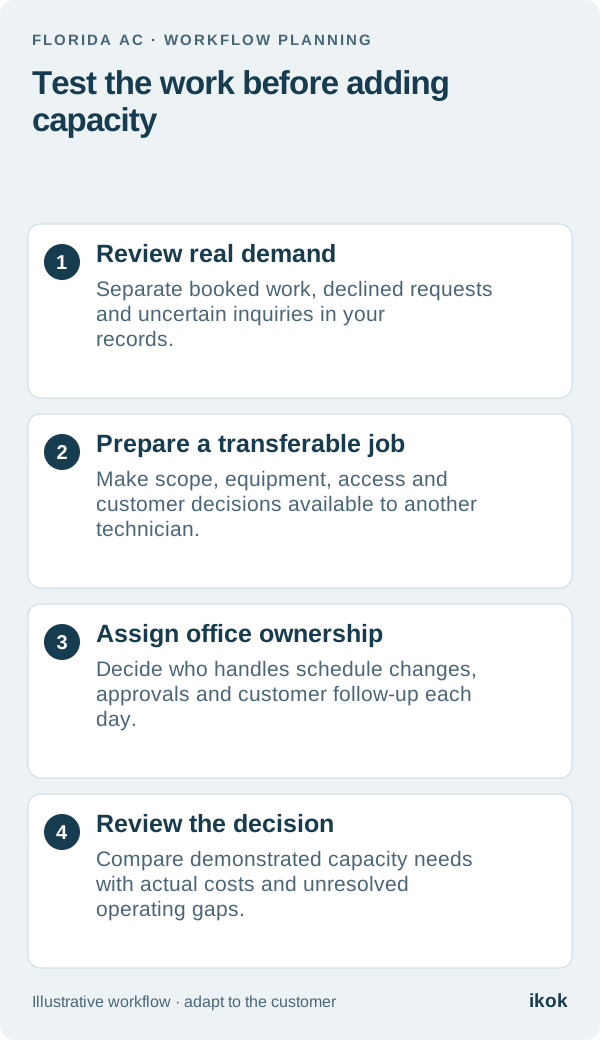
The point of this review is to expose a next action, not to produce a synthetic growth score. Mark each item demonstrated, needs work or unresolved, and name the person responsible for closing the gap.
| Readiness question | Evidence to review | Next action if weak |
|---|---|---|
| Is suitable work being delayed? | Actual requests, outcomes and reasons | Improve demand records before projecting capacity |
| Can jobs be handed to another technician? | Correct property, equipment, scope and access | Standardize job preparation |
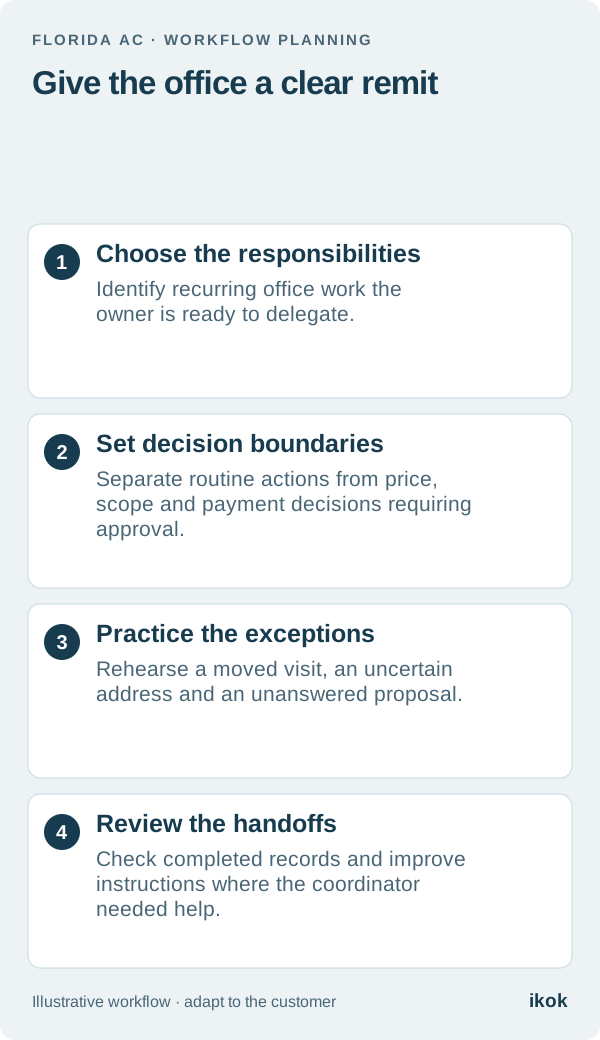
| Can someone handle schedule changes? | A named office owner and tested process | Assign authority and escalation boundaries |
| Are proposals followed through? | Customer decisions and open questions | Give pending estimates an owner |
| Can completed work be reviewed? | Saved evidence, report review and invoice status | Establish a consistent closeout |
| Are added costs understood? | Your vehicle, staffing, operating and software figures | Build a separate cost review with the responsible adviser |
Do not mark “software purchased” as proof that the team can perform the workflow. Use actual demonstrations with fictional records, followed by a controlled rollout appropriate to your business.
Run a job without the owner's memory
Prepare a fictional repeat-customer visit with two systems, one prior recommendation and a property access instruction. Ask another team member to find the right unit, understand the approved scope and identify who can authorize more work.
Then change the appointment. Can the office identify the assigned technician and the customer update that needs to happen? After the visit, can someone review the report draft and decide whether a separate proposal remains open?
This exercise is deliberately about information and responsibility. It does not assume automated route optimization, automatic diagnosis or a software prediction of profitable capacity.
Keep the cost decision separate from the workflow test
Use your own cost definitions for vehicle expenses, staffing, insurance, tools, supplies, administration and software. Distinguish available cash from invoice totals and estimated work. The job-costing worksheet offers a way to review direct job inputs without treating invoice revenue as profit.
If the workflow is ready but the cost case is uncertain, resolve that uncertainty before committing. If the cost case is promising but every handoff still depends on the owner, improve the operating process first. A second truck should have a job to do and a system of responsibility supporting it.
Demonstrate the two-truck day in IKOK
IKOK can bring scheduling, assignments, customer context, equipment records, proposals and reporting into a shared workflow. Use two fictional technicians and a rescheduled job to test the setup your company needs. Confirm role access, users and membership scope.
The one-truck workflow is the starting point. Growth means making that work transferable, so the next technician receives a prepared job instead of a collection of unanswered questions.