Define affordable for the business you run
Affordable AC software should fit your budget and the work your team needs to complete. Comparing only the advertised entry price can hide a more expensive decision: a missing workflow, a separately priced service or a setup project that was never included in the original conversation.
Start with the people and tasks you actually have. A solo owner answering calls between visits has different requirements from a dispatcher coordinating three technicians. Both need a clear written scope. Neither benefits from paying for a vague promise of “everything” without knowing which tools, connections and services that includes.
Build a fictional four-person scope
Consider a small AC company in Lakeland with an owner, an office coordinator and two technicians. The team wants shared customer history, dispatch, proposals, maintenance visits and service reports. The bookkeeper uses QuickBooks Online. The owner is also interested in business texting but has not confirmed its setup or cost.
Write these as separate requirements. Identify who needs an account and what each person does. Do not assume the owner's access can simply be shared with the coordinator, or that interest in texting means it is included in the base membership.
Then classify the requirements as necessary for the first rollout or useful later. This gives the company a smaller, clearer starting scope without pretending the later requirements have disappeared.
Ask for costs in separate rows
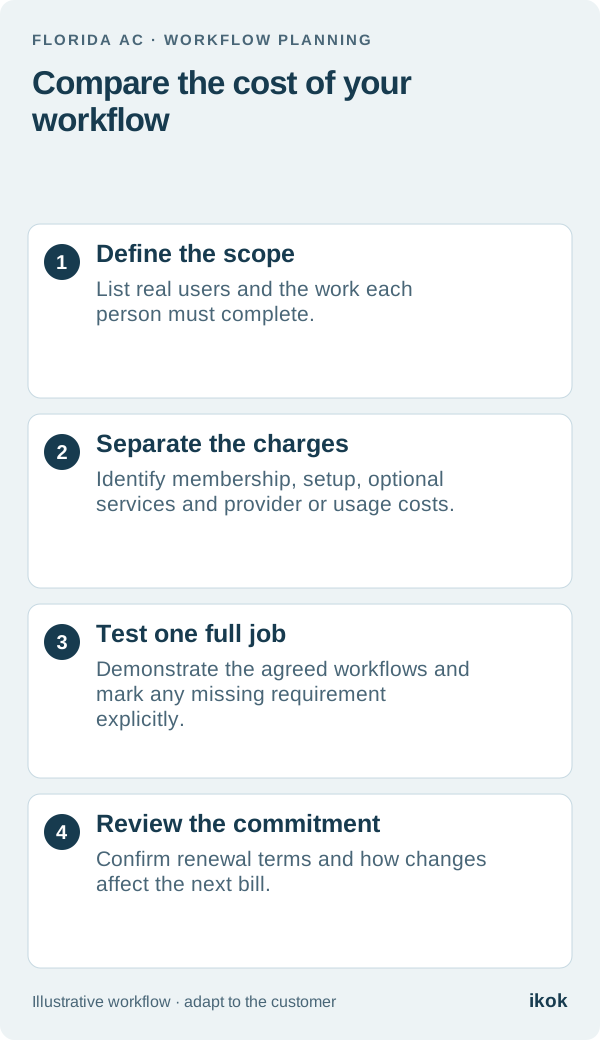
Use the same worksheet for every option. A row can be included, separately priced, not required or awaiting confirmation. Blank should mean unresolved, not free.
| Cost area | What to ask the supplier | Evidence to keep |
|---|---|---|
| Membership and users | Which users and workflows are covered? | Written plan scope and recurring price |
| Setup and training | What configuration and assistance are included? | Deliverables, responsibilities and any one-time cost |
| Data preparation | Which records can be moved, and by whom? | Agreed transfer scope and review process |
| Optional communication | What phone, SMS or AI setup is required? | Availability, activation conditions and charges |
| Usage and providers | Which activity creates additional charges? | Applicable rates, billing basis and provider terms |
| Payment processing | Which collection costs remain separate? | Agreed payment-provider arrangement |
| Changes and cancellation | What changes the price or stops renewal? | Renewal date, cancellation and change terms |
Keep recurring membership separate from one-time setup in your first-year budget. Add your expected usage using the actual quoted billing basis. A payment-processing fee, a software membership and a texting allowance describe different services; do not combine them into an unexplained headline number.
Measure your current effort before estimating savings
For one representative week, record the office tasks that repeatedly need re-entry or clarification. Note the time spent and the reason: finding an equipment record, rebuilding a proposal or checking which customer received a document.
Use that record to choose demonstration tasks. It is stronger evidence than an assumed percentage saving. Even if the new workflow reduces steps in a demo, your actual result will depend on adoption, record quality and the work your company performs.
Treat a rough savings calculation as your planning assumption. Do not use it to turn a subscription decision into a guaranteed return claim.
Compare IKOK against the written scope
IKOK's membership page identifies team-size options and the published solo membership. Other membership pricing and scope are discussed with the team. Paid memberships are billed monthly; the cancellation policy explains renewal, continued access through the paid period and refund terms.
Ask for the exact modules and setup relevant to your company. Phone, SMS, AI and payment services can involve separate activation, usage or provider costs. A connected workspace does not mean every external service is bundled into one price.
Make the purchase decision reviewable
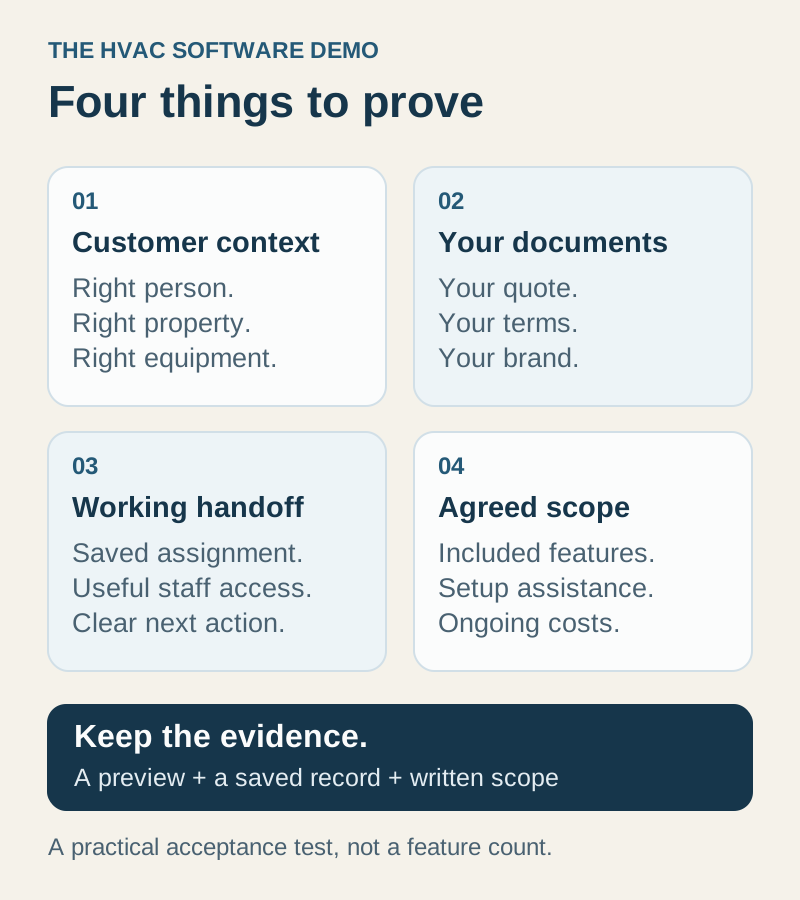
Run the HVAC software buyer's checklist with the fictional four-person job: schedule it, find the equipment, prepare a proposal, record service and review the customer report. Mark each required step as demonstrated, requiring setup or unresolved.
Choose a membership after you can connect its written scope to those results. The useful question is not simply whether the price is low. It is whether the agreed cost buys a workflow your team can use and maintain.