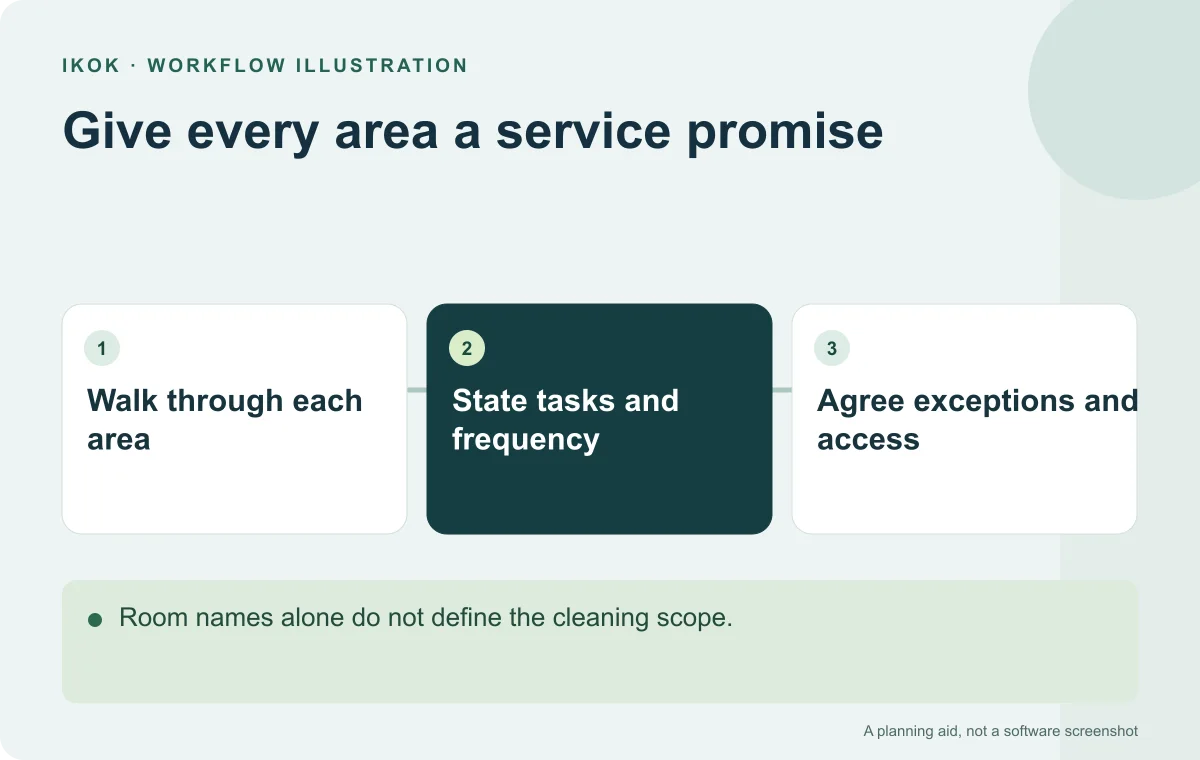
A cleaning walkthrough should end with a scope another person can price and deliver. The useful record identifies the rooms, tasks, service frequencies and access conditions the customer actually discussed. A room count or a request for “regular cleaning” leaves too many decisions for the first crew to discover.
For a cleaning-business owner evaluating software, the test is whether those details survive the move from site notes to a clear proposal. This guide develops a fictional office-cleaning example and a room-by-room worksheet. It addresses the agreement before work is scheduled, rather than how to move a later appointment.
Walk the site with a record of the customer's request
At fictional Bright Harbor Cleaning, estimator Rhea visits a small office with client contact Marta. Coordinator Finn will prepare the proposal and brief the crew after approval. Rhea takes a room list and notes the tasks Marta requests; she distinguishes those requests from conditions she has observed and items she could not inspect.
The site includes a reception area, an open office, two restrooms, a staff kitchen and a locked records room. Marta asks for cleaning three evenings each week. She also mentions an initial reset of several areas before routine service begins. Finn will need to price that initial work separately from the recurring scope.
Before leaving, Rhea confirms who will review the proposal and who can settle access questions. A receptionist may be the most helpful walkthrough contact while another person makes the purchase decision. The room sheet should preserve both roles without treating an informal comment as the final agreement.
Build the room-by-room scope matrix
Rhea uses the following fictional worksheet. It is an estimator's working document, not a claim that IKOK automatically surveys rooms or generates cleaning tasks.
| Area | Requested routine work | Frequency to describe | Condition or question to resolve |
|---|---|---|---|
| Reception | Agreed floor care, accessible surface cleaning and bins | Each of three weekly visits | Define which surfaces remain clear for service |
| Open office | Agreed floor care and bins | Each visit | Staff handle personal items; desk-clearing expectations need agreement |
| Two restrooms | Listed restroom tasks and agreed supply checks | Each visit | Identify who supplies consumables and the restocking arrangement |
| Staff kitchen | Accessible surfaces, sink area and bins | Each visit | Appliance interiors are outside this initial routine scope |
| Interior reception glass | Clean the identified accessible panes | Once weekly | Identify the panes; other glass is not assumed included |
| Locked records room | Scope pending inspection and permission | Undecided | Arrange access; no work or price is assumed yet |
Each row should describe a repeatable obligation. “Kitchen included” would leave appliance interiors, dishes and supplies unresolved. “Accessible surfaces” also needs a shared meaning: identify what staff must clear and what the cleaner is permitted to move.
Room labels should remain recognizable to the crew. If the customer calls a room “Studio B” while the site plan says “Meeting Room 2,” record both references once and use them consistently. That is more useful than a detailed proposal whose room names do not match the building.
Separate the initial condition from ongoing service
Marta wants the reception and kitchen brought to an agreed starting condition before routine visits begin. Rhea records the specific initial tasks and any access or preparation they require. Finn can then describe that one-time work as a separate scope rather than bury it in the recurring amount.
Keep the starting condition, requested result and proposed work connected. Avoid broad promises such as “restore everything” when the actual walkthrough covered particular accessible surfaces. Any specialist treatment or work outside the company's supported service should receive its own assessment and decision.
The recurring proposal should explain how often the company attends and how often each listed task occurs. Three weekly visits do not mean that every task happens three times. Conversely, a weekly glass task should not disappear because the customer sees only a single monthly price.
Use the company's actual pricing method and reviewed rates. The worksheet does not prescribe a production rate per room, a labor-hours formula or a standard market price. It gives the estimator the information needed to apply the method the business uses.
Resolve the room that could not be inspected
Before Finn sends the proposal, Marta asks to include the locked records room. Rhea had not entered it. Its condition, permitted tasks and access process remain unresolved, so adding a generic room price would create an unsupported commitment.
Finn lists the room as pending review and arranges the next information step. If the customer wants the other areas to proceed, the proposal can clearly identify those agreed areas and the excluded room. If the room is essential to the whole engagement, the team can wait until it has enough information to issue a complete offer.
Once access is arranged, Rhea updates the row from the actual inspection and customer instructions. Finn reviews whether the additional work changes price, visit duration or the permitted service window. The change is explained to the reviewer; it is not silently inserted into a document they previously considered.
This exception is why the worksheet needs an unresolved-items column. A blank is difficult to interpret later. “Pending access; Rhea to inspect; Marta to arrange entry” tells the team what must happen next without inventing a finished scope.
Build and review the customer proposal in IKOK
IKOK's quote editor supports work descriptions, scope and line items with quantities and prices. Its reusable offerings and customer-facing proposal details provide a way to explain an offer using reviewed content. The room matrix remains the team's preparation aid; it is not an automatically generated cleaning specification.
Finn can use the reviewed room descriptions to prepare separate initial-work and recurring-service descriptions. He then checks how the visit frequency, task frequency, access assumptions and exclusions appear in the customer preview. A single monthly amount should not be the only visible explanation of the recurring work.
After saving, reopen the quote and check the actual text. Confirm that the locked room still has the intended status, that the one-time work is distinguishable and that the right contact receives the proposal through the company's approved process. Software should preserve the agreed meaning rather than force the customer to reconstruct it from several conversations.
Hand over the agreement before planning the visits
After the customer makes a decision, Finn prepares the crew's starting information from the accepted scope: the room names, task frequencies, access instructions and excluded areas. Keep any unresolved condition visible with an owner rather than asking the first cleaner to negotiate it on arrival.
The separate cleaning scheduling guide addresses a later changed visit. Use it after the scope is settled. Moving an appointment should not quietly change which rooms or tasks the company agreed to service.
For an initial review, take three recent walkthroughs and ask a crew lead to explain the proposed service from the documents alone. Record missing room labels, unclear task frequencies and unanswered access questions. Those observations provide a practical editing list; they do not prove an automatic improvement in profit or customer retention.
Questions cleaning-business owners ask
Should every room be a separate priced line?
Not necessarily. The customer needs a clear scope even if the price combines several areas. Use enough detail to show what is included, how often it happens and which areas or tasks require another decision. Your pricing method and proposal layout can remain separate choices.
How should an uninspected room appear?
Identify it as pending review or explicitly outside the current offer, depending on the actual arrangement. Record the missing information and the person obtaining it. Avoid filling the gap with a standard task list that nobody has checked against the room.
What should a software demonstration include?
Bring a room sheet with one initial task, one recurring task and one unresolved area. Ask to prepare, save and preview the proposal, then revise the unresolved area after review. Confirm where the team keeps supporting notes and what the customer will see; do not infer automatic cleaning-time calculations from a general quote module.
Bring a recent walkthrough sheet to an IKOK demonstration. Ask the estimator and coordinator to turn it into a proposal the customer and first crew can both understand.
Photo: Original IKOK workflow illustration, November 23, 2026. A planning aid for the article; not a product screenshot or a record of an actual customer outcome.