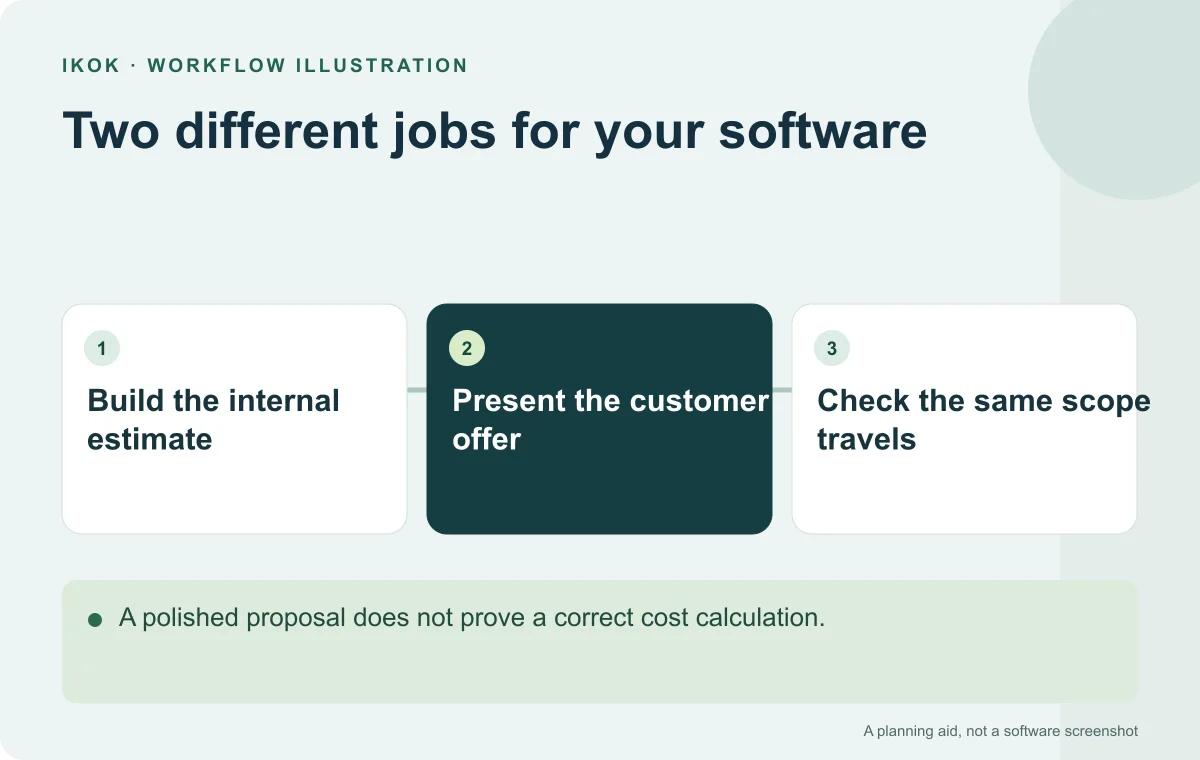
HVAC estimating software and HVAC proposal software solve related questions. Estimating concerns the work, quantities, resources and pricing inputs behind an offer. A proposal explains the offer to the customer: what is included, which choices are available, what they cost and what happens next. A product may support both, but a polished customer page does not prove the calculation behind it.
Before choosing software, test those two jobs separately. Use one small project with inputs you understand, then change something that should affect the result. You should be able to explain both the number and the document the customer receives.
Give the demonstration two owners
In this fictional example, Rina owns a small HVAC business and reviews estimates. Omar coordinates proposals and customer questions. They are evaluating how IKOK could fit their process for a replacement job whose equipment and technical scope have already been assessed.
Rina brings a sanitized worksheet with the proposed items, quantities, planned labor and the business's reviewed pricing inputs. Omar brings the customer-facing scope, exclusions and terms. Neither document contains a real customer's private details.
They write two acceptance statements before the demonstration:
- Estimate: Rina can trace each required input and explain the resulting selling price using the business's chosen method.
- Proposal: Omar can show a customer the current scope, complete price, options and terms without exposing internal working notes.
This division prevents a good presentation from masking an unfinished estimate. It also prevents a detailed internal worksheet from being mistaken for a useful customer offer.
Define what your team means by estimating
“Estimating” can describe several tasks. Be precise about which ones your company needs the software to perform and which stay in a separate process.
| Task | Question to test | Evidence that would answer it |
|---|---|---|
| Scope definition | What work and exclusions are being priced? | A reviewed job-specific scope |
| Quantity and price entry | Can the intended units, quantities and prices be entered and reopened accurately? | Saved fields and independently checked totals |
| Internal cost review | Where are labor and material costs maintained? | Defined cost fields or an agreed external worksheet |
| Customer presentation | Can the customer understand the offer and its alternatives? | The actual customer preview |
| Technical calculation | Does a required design or sizing calculation exist? | A separate demonstration of that exact specialist capability |
| Later reconciliation | Which approved scope reaches the job and invoice? | A traceable handoff using the intended workflow |
Do not infer load calculations, drawing takeoff, live supplier pricing or a complete internal cost database from the word “estimate.” If your team needs one of those functions, make it a separate requirement and ask for direct evidence.
Prove the inputs before admiring the total
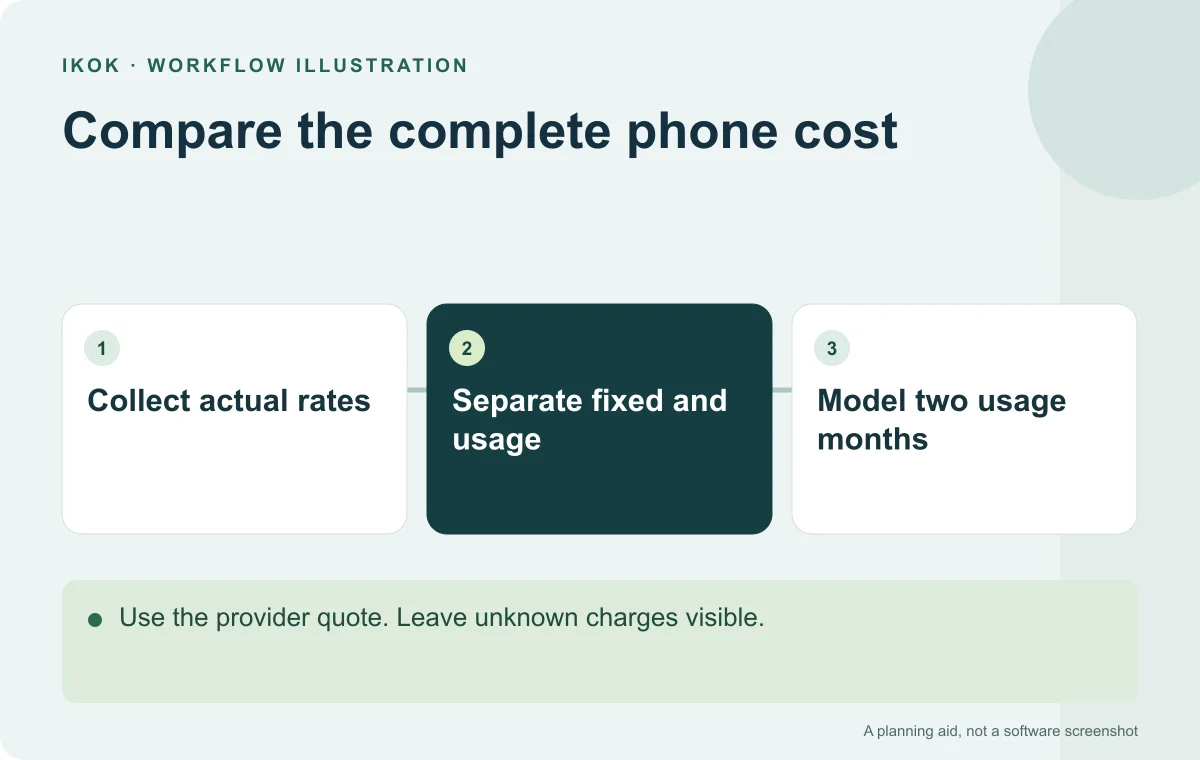
Rina starts with a sample estimate she can check independently. It contains a listed item quantity, planned labor and the agreed pricing treatment. The team's real costing and tax decisions belong to its established business and accounting process; the demonstration should reproduce those decisions, not invent them.
She asks the presenter to enter the sample estimate, save it, close it and reopen it. She then checks the values that persisted. A correct number while typing is weaker evidence than a correct saved record used by the next person.
Her worksheet distinguishes internal labor cost from the labor amount charged to the customer. They may be different figures with different purposes. She also identifies whether a displayed adjustment applies to one line or the entire document, and checks the result against her expected calculation.
The existing HVAC job-costing worksheet explains the later review of estimated and actual resource use. This buying test comes earlier: it establishes what the candidate software actually stores, calculates and displays.
Prove the customer presentation separately
Omar now reviews the offer as the customer would see it. He checks equipment descriptions, complete scope, exclusions, price and terms. If there are two options, he asks what the customer is choosing between and whether both are technically suitable for the assessed job.
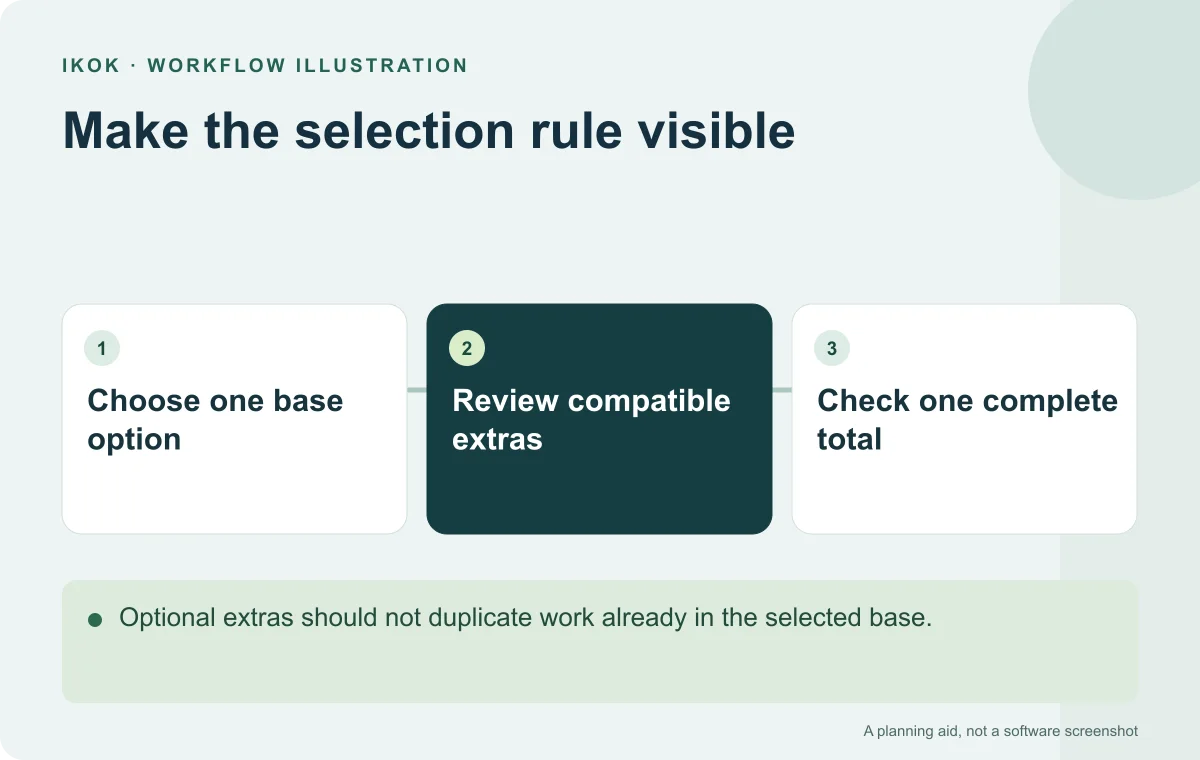
IKOK's HVAC proposal workflow supports reusable quote and option templates, equipment images, descriptions, pricing, specifications, installation notes and warranty details. Presentations can contain one, two or three options. Those are presentation capabilities to inspect; they do not establish an automatic equipment-selection or cost-calculation engine.

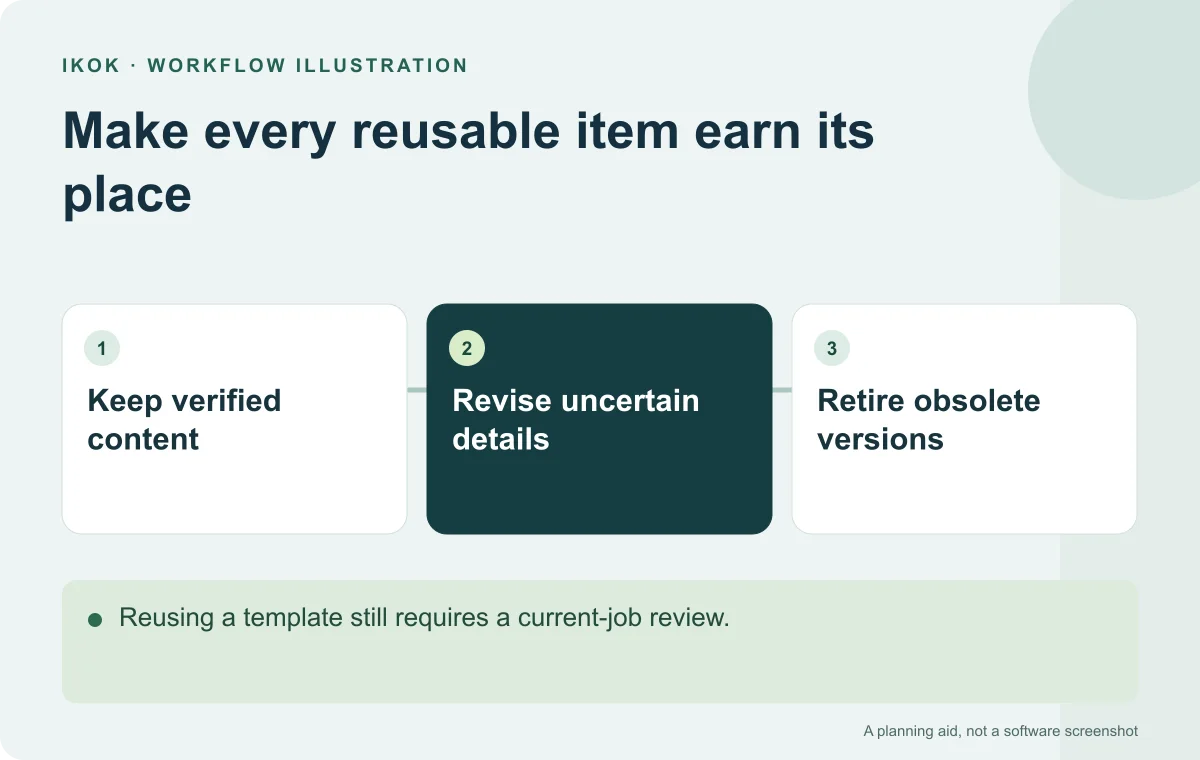
Omar asks to change the wording for this specific customer, preview the result and identify the current version. He looks for conflicts: a useful exclusion in the detail page that contradicts the summary, or a photograph that could be mistaken for the exact equipment being supplied.
Change one input and follow the consequences
During the demonstration, Rina adds one required piece of work to the sample estimate. She specifies what changed and what the team's pricing method says should happen. Omar waits for the estimate to be reviewed before preparing the revised customer offer.
They check the saved quantity or work description, the resulting price and each affected presentation. If one option requires the same additional work, they review it there too. They do not assume that a change in one place updates every related document automatically.
The exception is useful because it reveals the handoff. Perhaps the estimate saves correctly but the customer email still contains an older attachment. Perhaps the proposal updates while an internal worksheet remains stale. The team records the actual behavior and assigns the missing step.
The estimate follow-up guide covers the next communication: identifying the current proposal and giving the customer a useful question to resolve. It should follow a reviewed offer, not compensate for inconsistent figures.
Use a short acceptance record
Rina and Omar keep one row per requirement. The result is demonstrated, needs setup, or unresolved. A promise to show something later remains unresolved until it is demonstrated.
| Test | Expected result | Observation to record |
|---|---|---|
| Reopen the sample estimate | Inputs and intended values are retained | Saved record and fields checked |
| Change a quantity or scope item | The reviewed result matches the business's expected calculation | Difference, explanation and remaining manual step |
| Preview the offer | Customer-facing scope and total agree | Preview version and any conflicting text |
| Keep internal work separate | Customer sees only the intended offer | Actual recipient-facing output checked |
| Hand off the revised choice | Staff can identify the current accepted scope | Record references and next owner |
Add the configuration, membership scope and device used. A result demonstrated for an administrator does not by itself prove that the intended field role can perform the same action.
Choose around the unresolved work
At the end, Rina may decide that her existing estimating worksheet remains useful while IKOK handles the customer and proposal workflow. Or the demonstrated configuration may cover more of her required entry and document process. The decision should follow the observed functions and remaining work.
For the first few proposals after adoption, compare saved inputs, customer questions and corrections before scheduling. Note whether the extra checking comes from unclear setup, inconsistent templates or a missing capability. That is evidence for the next improvement; a new subscription alone does not prove faster estimating or better sales.
Questions HVAC software buyers ask
Does proposal software calculate the right system size?
Do not assume it does. Equipment assessment and specialist calculations require their own appropriate tools and qualified review. The proposal should explain the equipment and scope already selected for the job.
Does a quote's labor price show our labor cost?
Not necessarily. A selling price and an internal cost serve different purposes. Ask what each field represents and where actual hours, purchasing and overhead are reviewed before relying on a profitability figure.
Can one platform handle both estimating and proposals?
It may cover the functions your business needs, but evaluate each required operation. Saved quantities, calculations, customer output and later handoffs deserve separate checks. Record any dependency on configuration or another tool.
Bring a sample estimate, not just a feature list
Book an IKOK proposal walkthrough with one anonymized estimate and the customer document it produced. Ask to reproduce the relevant inputs, inspect the customer view and work through one revision. You will leave with a clearer account of what was demonstrated and what your team still needs to resolve.
Photo: Original IKOK workflow illustration, November 23, 2026. A planning aid for the article; not a product screenshot or a record of an actual customer outcome.