A landscaping estimate needs a dependable quantity behind each price. “Refresh the beds” is a useful starting request, but it does not tell the estimator which areas count, which units apply or what the crew should leave untouched. Landscaping estimating software helps when the team can carry those reviewed facts into a clear customer proposal.
The measurement and scope decisions still belong to your team. This guide uses a fictional bed-refresh project to show how an estimator can reconcile site notes, quantities and line items before sending a price. It does not assume automatic property measurement, aerial takeoffs or material-volume calculations.
Give every quantity a source
At fictional Meadowline Grounds, owner Avery prepares estimates and crew lead Jo records site observations. Customer Robin wants two planting beds refreshed, selected edging replaced and several new plants installed. Jo returns with a marked site sketch and dated photos. The first estimate should start with those observations, rather than a quantity copied from the previous customer's job.
Avery separates the work into areas, lengths and counts. Bed preparation is described by square feet; edging by linear feet; new plants by individual count. These are three different pricing bases. A single quantity labeled “landscaping” would make the total difficult to check and the work difficult to assign.
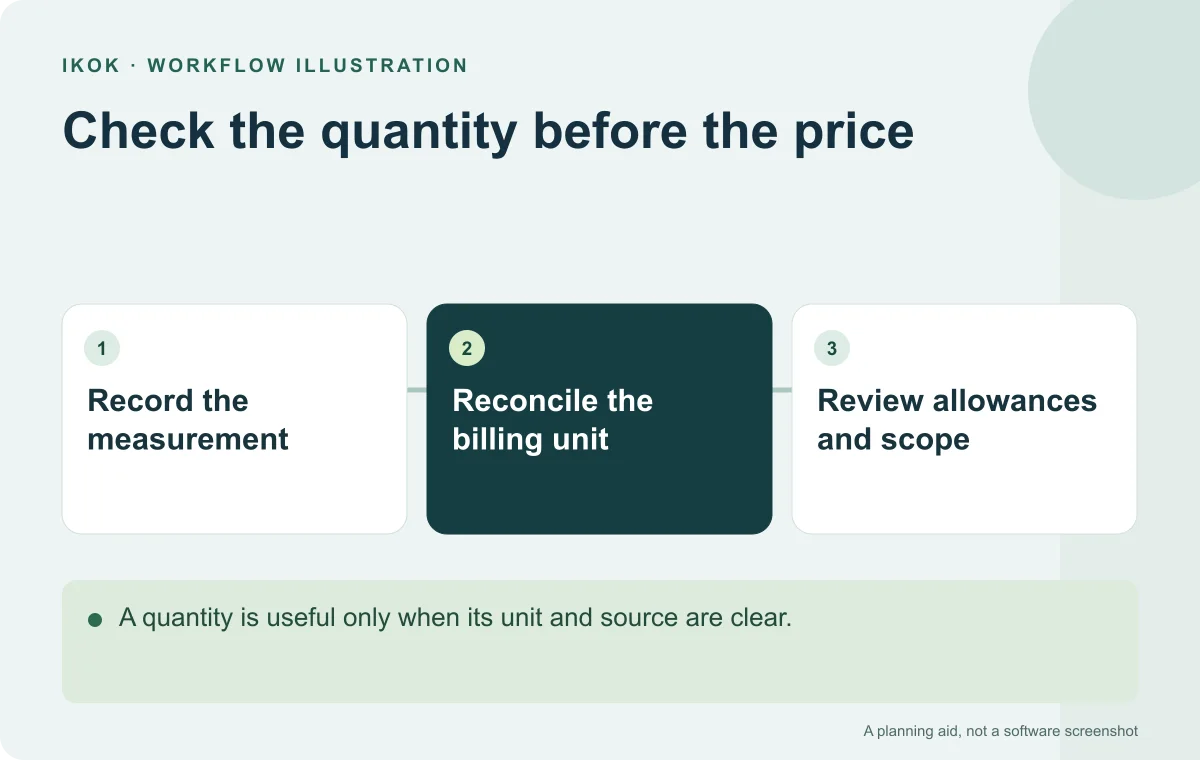
Record where each figure came from, who checked it and whether it is measured, counted or still an allowance. An allowance needs a stated basis and a later review decision. It should not quietly look as definite as an observed count.
Reconcile the site sheet before the price sheet
Jo's fictional site sheet contains the following figures. They illustrate recordkeeping, not installation standards or purchasing instructions.
| Work item | Starting observation | Scope adjustment | Quantity to price | Unit |
|---|---|---|---|---|
| Prepare the two agreed beds | North bed 120 + east bed 180 | Exclude 40 occupied by retained planting areas | 260 | Square feet |
| Replace agreed edging | 68 measured along the marked boundary | Exclude an 8-foot opening | 60 | Linear feet |
| Install new plants | 14 marked planting positions | Four positions retain existing plants | 10 | Each |
The arithmetic is simple enough to check: 120 + 180 − 40 = 260; 68 − 8 = 60; 14 − 4 = 10. The important review is whether those adjustments describe Robin's actual request. Subtracting the same excluded area twice would still produce tidy arithmetic with the wrong scope.
Avery marks the retained areas and plants on the same site reference used for the estimate. The crew should not need to guess which four plants “retain existing” means. If a reference photo is needed, identify its location and date rather than attach a collection of unlabeled images.
Check the unit at the point where money is calculated
A line item's description, quantity and unit price must describe the same thing. For a fictional calculation example, 260 square feet at $2 per square foot produces a $520 line total. The $2 rate is invented for this worksheet and is not a suggested selling price. Your estimate uses your reviewed prices and applicable tax treatment.
Now imagine that a copied catalog item is priced per project. Entering 260 beside that project price would multiply the wrong basis. Changing the label in the description would not fix the calculation. Avery checks the selected item, the quantity, the unit and the price basis together before reviewing the result.
Keep purchasing calculations separate where they use different units or assumptions. A bed area does not by itself establish an order quantity for every material. Depth, packaging, waste allowances and suitability require the qualified person's actual method; this article and the general quote editor do not supply that method.
State the assumptions that could change the work
The proposal should explain the work areas and what the price assumes about access, retained features and the selected items. For this example, Avery identifies the two beds, the marked edging boundary and the ten new planting positions. Final plant selections and any effect on price must be confirmed before the corresponding work is authorized.
Write exclusions precisely enough to support a conversation. “Existing irrigation changes are outside this quoted scope” identifies a decision the customer can review. A vague phrase such as “all necessary extras” creates uncertainty about both the work and the price.
The custom offering workflow can present a description, supporting details and genuine options. Use a separate option only when Robin has a real choice to make. A different quantity caused by a corrected measurement is a correction to review, not automatically a premium package.
Work the exception: the customer adds a third bed
Before approving, Robin asks to include a small side bed. Jo measures that additional area at a fictional 60 square feet. Avery does not overwrite the original 260 with 320 and send an unexplained new total.
Instead, Avery records the added location, the 60-square-foot observation, the date and the scope it would add. The revised proposal can show the added work clearly or identify the changed total with a concise explanation. The team also checks whether the new location changes access, edging or plant counts; none of those quantities should rise automatically because the area increased.
If Robin wants to consider the extra bed later, the original scope can remain the current decision. Keep the optional additional work distinguishable from the work being offered now. Before the crew starts, identify which description and quantities the customer actually approved.
Use IKOK to preserve the reviewed estimate
IKOK's line-item editor provides descriptions, quantities, units and unit prices, with a save action. Its quote editor includes work-description and scope fields and a customer preview. These support putting Avery's reviewed figures into a proposal; they do not establish how the site was measured or whether the selected price basis is appropriate.
For a useful demonstration, enter the three worksheet items, save them and reopen the quote. Check that the quantities and unit descriptions remain clear, that the displayed amounts match the intended calculation, and that the customer view identifies retained areas and exclusions. Then add the side-bed request and review the changed document. Use the supported unit choices in your actual account rather than assuming every specialist format exists.
Keep quantity evidence available through your established job-record process. The crew needs the approved work and its site references, while later billing needs the record of what was completed. The separate landscape invoicing guide addresses routine visits and extra-work reconciliation after those decisions.
Run a five-estimate quantity review
Choose five recent projects that use at least two measurement units. Have someone other than the author trace one amount per estimate back to its observation and price basis. Record a missing source, a unit mismatch, an unexplained allowance or a scope change that was difficult to identify.
That small review gives the team a concrete improvement list. A corrected quantity is evidence of a better-reviewed estimate; it is not proof of a measured profit increase or a software-generated takeoff.
Questions landscaping owners ask
Can a template keep standard quantities?
It can retain a useful structure, but quantities should be checked against each site. Distinguish placeholders from observed measurements and remove any old property-specific values before using the customer preview.
Should the customer see every measurement note?
Show the quantities, locations and assumptions needed to understand the offer. Keep the supporting working notes available to the team. A concise marked reference can be more useful than sending an unorganized folder of site photographs.
What should landscaping estimating software prove in a demo?
Test a square-foot item, a linear-foot item and an individual count, then revise one scope item. Verify the saved quantities, price basis and customer presentation. Ask separately about any specialist measuring or material-calculation tool you require; general estimating fields do not establish that capability.
Bring a marked site sheet to an IKOK walkthrough. Ask to turn its three different units into a proposal that both the customer and crew can explain.
Photo: Original IKOK workflow illustration, November 23, 2026. A planning aid for the article; not a product screenshot or a record of an actual customer outcome.