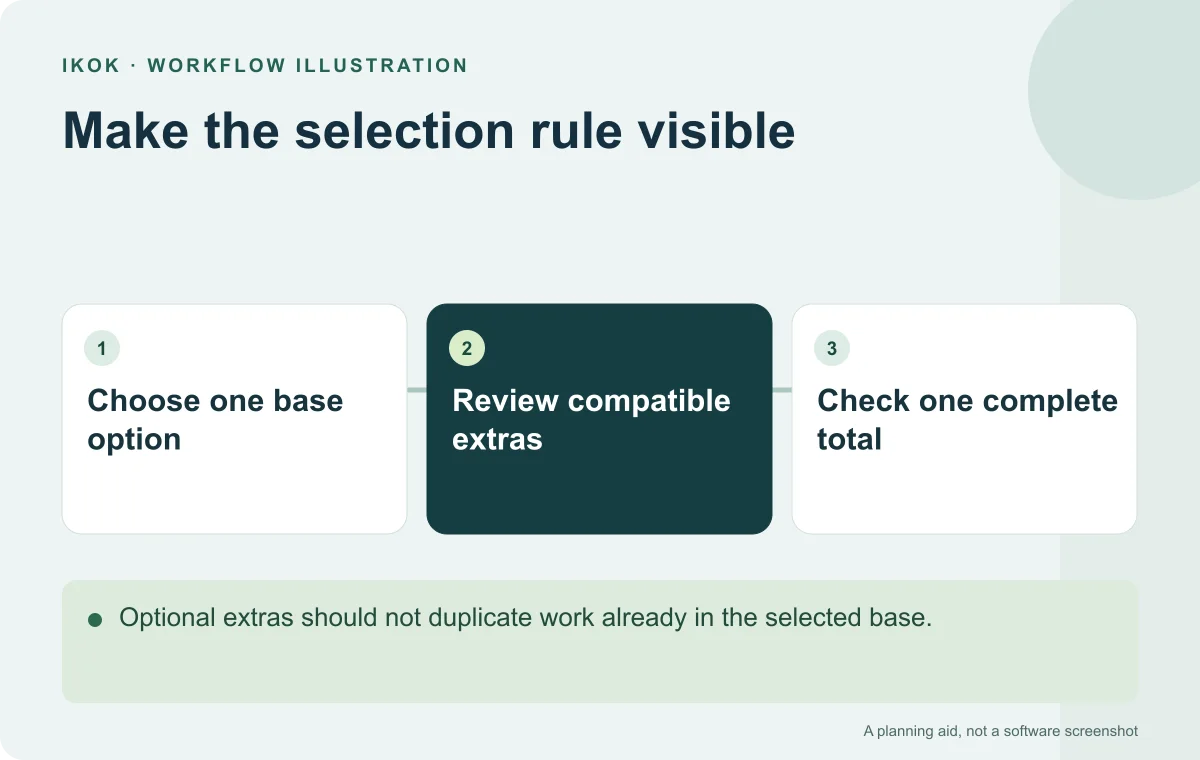
Pool service software should help a small team keep three decisions separate: the routine visit that was completed, the repair that still needs approval and the work that belongs on the current invoice. A weekly stop can create all three records, but they should not collapse into one vague “done” status.
This guide uses a fictional company, Gulf Blue Pool Care, to build a practical software demonstration. It does not assume route optimization, chemical-compliance logs, automatic billing or equipment diagnostics. Those are specialist requirements that a pool company should verify separately.
Start with the buyer decision
Gulf Blue has three people in the handoff:
- Marisol, the office coordinator, maintains the customer and planned visits.
- Evan, the field technician, records what happened at the property.
- Nadia, the owner, reviews repair scope, customer approval and the invoice.
Their fictional customer is Seabreeze Villas, which has a routine weekly pool-service visit. During this week’s visit, Evan completes the agreed routine service and notices moisture around the pump housing. He records the observation, but he does not represent it as a completed repair or a software-generated diagnosis.
Nadia now needs to decide whether the observation requires a separate assessment or repair proposal. Marisol needs the next action to stay visible. The current invoice must follow the real service agreement and completed work, not an assumption about what the customer will approve later.
That is the software test: can the team retrieve the customer, planned visit, field note, repair decision and invoice without confusing one record for another?
Map the three records before the demo
Write the expected handoff on paper before opening any product. This keeps a feature tour from substituting for the actual buyer decision.
| Record | Seabreeze Villas example | What it must not imply |
|---|---|---|
| Routine visit | The agreed weekly service was completed | That a repair was diagnosed or approved |
| Repair question | Moisture was observed near the pump housing | That the technician completed a repair |
| Current invoice | Only work supported by the agreement and completion record | That every planned item, note or proposed repair is billable |
If the agreement uses a monthly billing cycle, demonstrate that arrangement. If it uses per-visit billing, demonstrate that instead. Recurring service frequency and invoice frequency are related, but they are not automatically the same.
Demonstrate the routine visit first
Marisol starts with the existing Seabreeze Villas customer and service location. The buyer should ask the vendor to show the saved customer, the correct property and the planned visit—not a blank sales slide.
IKOK includes customer records and planned service workflows. Maintenance programs can represent service packages, coverage, planned visits and recurring work, subject to the applicable plan, permissions and configuration. The exact cadence, exception behavior and billing arrangement still need to be demonstrated for the company’s use.
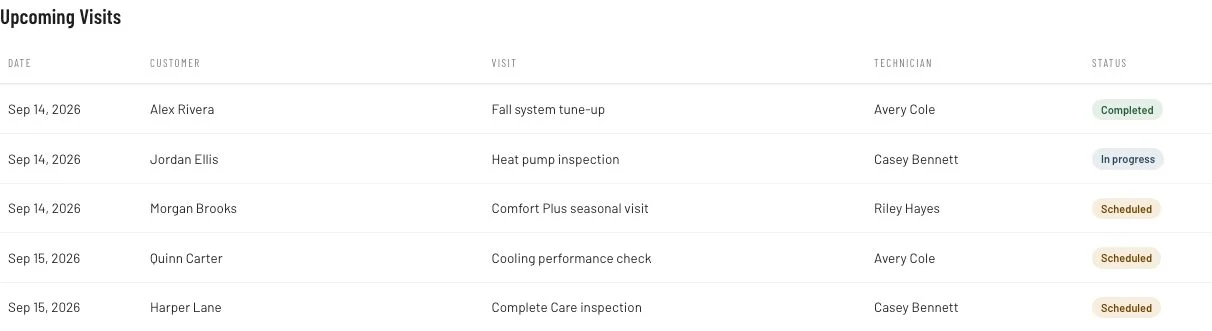
Current IKOK maintenance view with safe fictional HVAC demo data. It illustrates upcoming visits; it does not establish pool-route optimization, water-chemistry records or automatic invoicing.
Ask the demonstrator to open the saved visit again after leaving the record. Evan should be able to identify the customer, property and expected scope. A calendar entry alone is not proof that the visit occurred, and moving an appointment is not the same as completing the work.
Record the repair question without overstating it
At the property, Evan completes the routine visit and observes moisture near the pump housing. The useful closeout is specific about what he knows and what he does not:
- The routine service covered by the existing agreement was completed.
- Moisture was observed at a named equipment area.
- No repair was completed during this visit.
- Nadia must decide whether to assess, quote, defer or close the question.
That sequence protects the next person from interpreting a field note as a repair authorization. If a photo is appropriate, confirm where it is stored, who may access it and whether it remains attached to the correct customer or job. A photo supports the observation; it does not create a diagnosis.
IKOK has customer-equipment fields in its Team-gated equipment workflow, but a pool-service buyer should verify the exact property/equipment structure and permissions in a demonstration. Manufacturer lookup, pump diagnostics, warranty submission and water-chemistry tracking are not established by a general equipment record.
For a deeper example of keeping equipment identity and earlier findings connected, see the equipment service-record guide. Its HVAC scenario is illustrative; it does not establish a pool-equipment template.
Put approval between the observation and the invoice
Nadia reviews Evan’s note. If the company needs a separate assessment before defining the repair, that assessment remains the next action. If the scope becomes clear, Nadia can prepare a proposal or quote for the customer to consider.
The software demonstration should preserve the difference between:
- an observation from the field;
- a proposed scope and price;
- a customer decision;
- scheduled repair work;
- completed repair work; and
- an invoice record.
IKOK includes quote, job and invoice stages, but the buyer should ask the demonstrator to show the exact configured transitions and saved result. A quote does not prove approval. A converted job does not prove completion. A visible invoice status does not prove payment or accounting synchronization.
This is also where a pool business should test exceptions. What happens if the customer asks for another opinion, approves only part of the proposed work or wants the repair scheduled after the next routine visit? The unresolved decision needs an owner and next review date.
Reconcile the invoice against the completed work
Before Nadia approves the invoice, she compares it with the agreement and Evan’s closeout. The routine service belongs on the invoice only according to the actual billing arrangement. The pump repair does not belong merely because the issue was observed.
IKOK invoice records can show invoice status, recorded payments and remaining balance. Payment-provider setup, authorization and customer consent apply. During the demo, verify what carries forward from earlier records, what must be entered manually and what the team sees after saving.
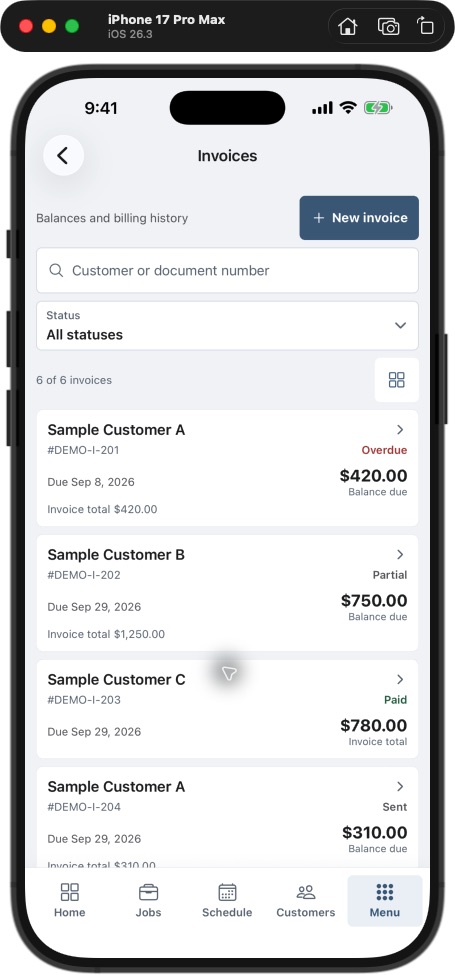
Current IKOK Field invoice view with safe fictional demo data. It illustrates invoice records and states, not a pool-service account, automatic recurring billing, card-on-file consent or a real customer outcome.
The invoice should remain traceable to completed, approved work. If the repair remains open, keep it in the next-action workflow rather than hiding it inside an invoice note.
Use a routine-visit and repair worksheet
Complete this worksheet before the invoice is approved. Link each answer to the saved source record or mark it needs review.
| Check | Seabreeze Villas example | Evidence to retrieve |
|---|---|---|
| Customer and property | Seabreeze Villas — selected pool location | Existing customer and service address |
| Planned routine visit | Weekly service | Agreement or package and visit record |
| Routine work completed | Confirmed for this visit | Field closeout and completion status |
| New observation | Moisture near pump housing | Dated note and optional safe photo |
| Diagnosis | Not established | Assessment required or not applicable |
| Repair approval | Not yet requested or received | Proposal and customer decision if created |
| Repair completion | Not completed | No completion record |
| Current invoice | Only supported routine work under the real billing arrangement | Invoice lines matched to agreement and closeout |
| Next action | Nadia reviews assessment/quote decision | Named owner and review date |
Use confirmed, needs review, deferred and not applicable consistently. Unknown approval is not rejection, and an observed problem is not a completed repair.
Compare general workflow software with pool-specific requirements
Current US search results for pool-service software commonly emphasize recurring routes, chemistry or dosage logs, equipment history, automated recurring billing, card-on-file payments and customer service reports. That observation helps define the buyer’s checklist; it does not prove that every vendor provides each function or that IKOK provides specialist pool features.
| Buyer requirement | What to test | Current IKOK claim boundary |
|---|---|---|
| Customer, property and visit context | Retrieve the same saved records from office and field roles | General customer and planned-work workflows; verify exact structure and permissions |
| Routine visit versus repair | Preserve the completed visit and unresolved repair decision separately | Demonstrate quote/job/invoice stages; no automatic pool-repair workflow claimed |
| Recurring scheduling | Show cadence, exceptions and a saved changed visit | Planned visits are supported; no route optimization claim |
| Chemistry or dosage logs | Show exact fields, calculations, reports and retention rules | Not verified; do not infer from forms or notes |
| Automatic recurring billing | Show consent, invoice timing, exceptions and payment-provider result | Not verified by a maintenance record or invoice list |
| Pool equipment diagnostics | Show exact data source and saved result | Equipment fields do not establish diagnostics or manufacturer integration |
A buyer may reasonably choose specialist pool software when chemistry, route or autopay functions are central. A general system should be evaluated on the workflows it can actually demonstrate, not on an industry label.
Pilot the handoff with safe records
Use fictional or safely isolated sample records for several routine visits and repair exceptions. Count observed misses such as:
- a visit attached to the wrong property;
- a routine service marked complete without a usable closeout;
- an observation presented as a diagnosis;
- a proposal treated as approval;
- an open repair with no owner or review date; or
- an invoice line that cannot be traced to the agreement and completion record.
Do not convert a short pilot into a promised time saving, collection improvement or route-efficiency result. The pilot produces evidence about configuration and fit—not a guaranteed business outcome.
Questions pool-service owners should ask
Does recurring scheduling prove recurring billing?
No. Visit cadence, invoice timing, payment consent and exception handling are separate decisions. Ask the vendor to demonstrate the configured result and the customer authorization involved.
Can a field note diagnose a pump problem?
Not by itself. A note can preserve an observation and next action. Diagnostics, manufacturer data and warranty processes require separate evidence.
Does a map or calendar prove route optimization?
No. A schedule can display work without calculating an optimized route. Treat route optimization as unverified unless the exact behavior and saved result are shown.
Should the repair appear on the invoice before completion?
Not merely because it was observed, discussed or quoted. Reconcile the actual agreement, customer decision, completion record and billing terms.
Make the software prove the handoff
Bring one representative routine visit and one repair question to an IKOK demo. Ask the team to show the customer, planned visit, field closeout, proposal decision and invoice records that are currently available. Keep chemistry logs, route optimization, automatic billing and diagnostics on a separate verification list unless the exact capability is demonstrated.
Photo: Original IKOK editorial workflow illustration generated and branded November 27, 2026; not a product screenshot.