A custom HVAC proposal should help a customer understand what the contractor will install, what changes between options, and what they are being asked to approve. A polished page helps, but the comparison depends on accurate scope.
For a small HVAC business, that means giving the estimator, office and customer one consistent explanation. Start with the work every suitable option includes. Add meaningful differences, separate the coverage terms, then preview the complete proposal before sending it.
Start with Elena's decision
Consider a fictional replacement project. Elena owns the home and will approve the work. Mateo is the contractor responsible for assessing the property and preparing the scope. June coordinates the proposal and scheduling.
Elena wants to understand her choices without interpreting three unrelated equipment lists. Mateo has reviewed the replacement equipment and control compatibility for this example. He identifies three suitable packages using the same replacement equipment, with different controls and setup services.
The equipment selection is already a contractor decision. The proposal explains that decision; it does not perform system sizing or establish technical suitability.
June records Elena's priorities, the service address, equipment being replaced and approving owner. She also confirms which questions Mateo must resolve before the offer is ready. That gives the proposal a job-specific starting point, even when its structure comes from a template.
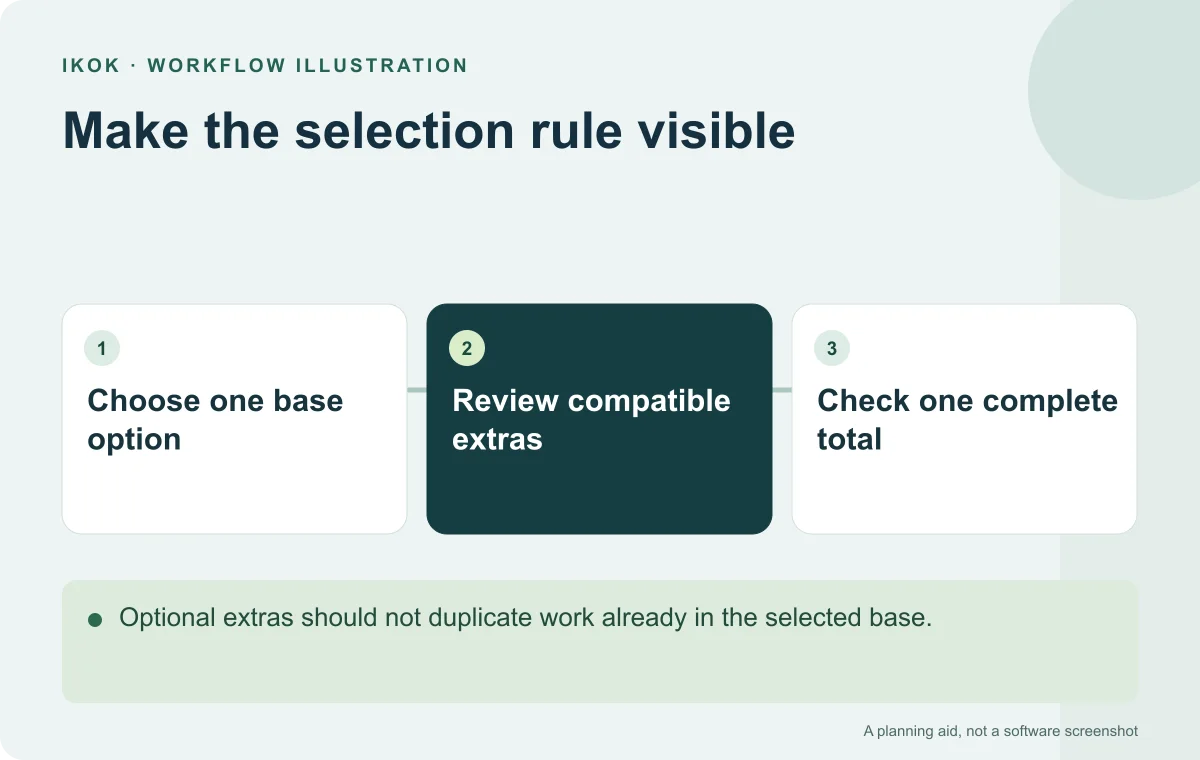
Put the common scope before the options
A customer cannot compare prices fairly when basic installation work appears in one package and disappears from another.
Mateo writes a shared scope covering the selected equipment, removal of the old equipment, agreed installation work, applicable permit responsibilities and the completion walkthrough. He lists exclusions and unresolved items explicitly. This is the team's fictional project scope, not a universal installation checklist.
Then June builds the comparison:
| Item | Core replacement | Replacement with new control | Replacement with connected control |
|---|---|---|---|
| Replacement equipment | Same reviewed equipment | Same reviewed equipment | Same reviewed equipment |
| Control | Retain existing compatible control | Supply a compatible programmable control | Supply a compatible connected control |
| Customer setup | Explain retained control | Demonstrate the new schedule settings | Include agreed connection and app demonstration |
| Required installation work | Full shared scope | Full shared scope | Full shared scope |
| Coverage | State actual parts and labor terms | State actual parts and labor terms | State actual parts and labor terms |
These are fictional choices. For a real proposal, name the actual models and verify compatibility, available functions and any prerequisites. Describe connected features only when the selected equipment supports them.
Each option needs its complete price and terms. If a difference is only a control and setup service, say so. A “Best” label should not imply greater capacity, lower operating costs or broader coverage that the package does not establish.
Handle necessary ductwork consistently
Before June sends the proposal, Mateo identifies a ductwork correction needed for the planned replacement. It was missing from the initial scope.
He determines the correction and adds it to the shared work across all applicable options. June updates each total and the installation notes, then returns the proposal to Mateo for review.
The necessary correction is not reserved for the most expensive package. Otherwise, Elena could mistake an incomplete scope for a cheaper equivalent.
If the team cannot yet define the work or its price, the proposal must explain what remains unresolved and how it will be resolved before that work is authorized. Do not describe an incomplete offer as a fully defined installation.
Build the customer view from reviewed details
IKOK's HVAC proposal workflow supports reusable quote and option templates, with equipment images, descriptions, prices, specifications, installation notes and warranty details.
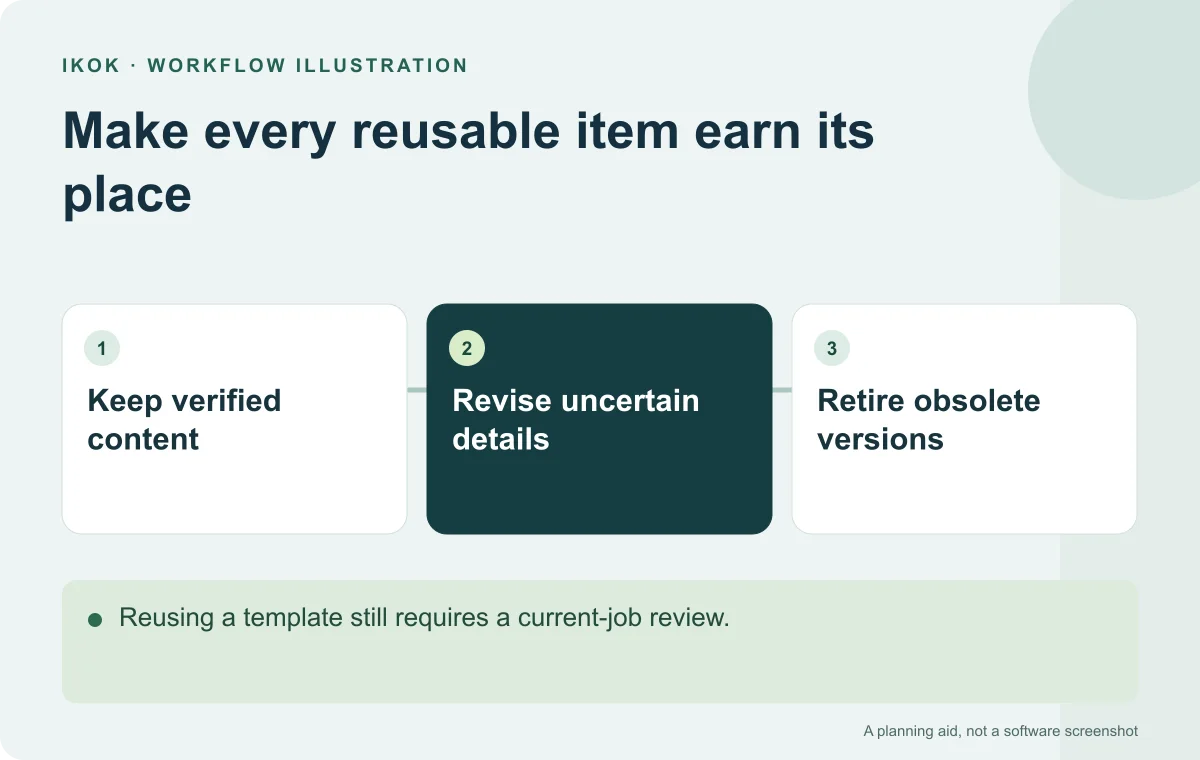
June can reuse the structure while tailoring the information to Elena's property. She checks that inherited descriptions match the current equipment and that any photograph is accurate or clearly illustrative.
Preview both the comparison and each option's detail. An attractive summary is insufficient if installation notes or exclusions contradict it.
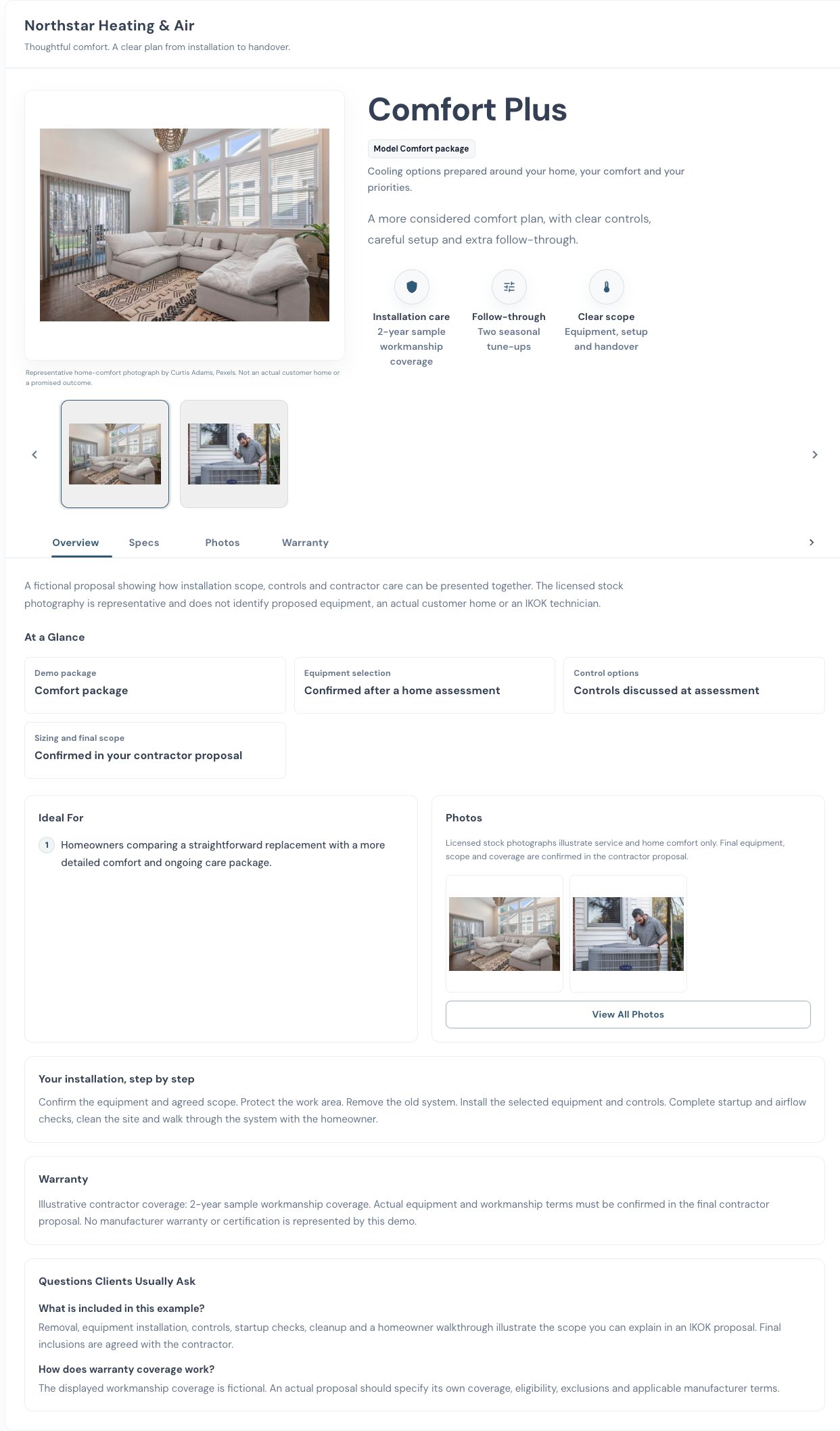
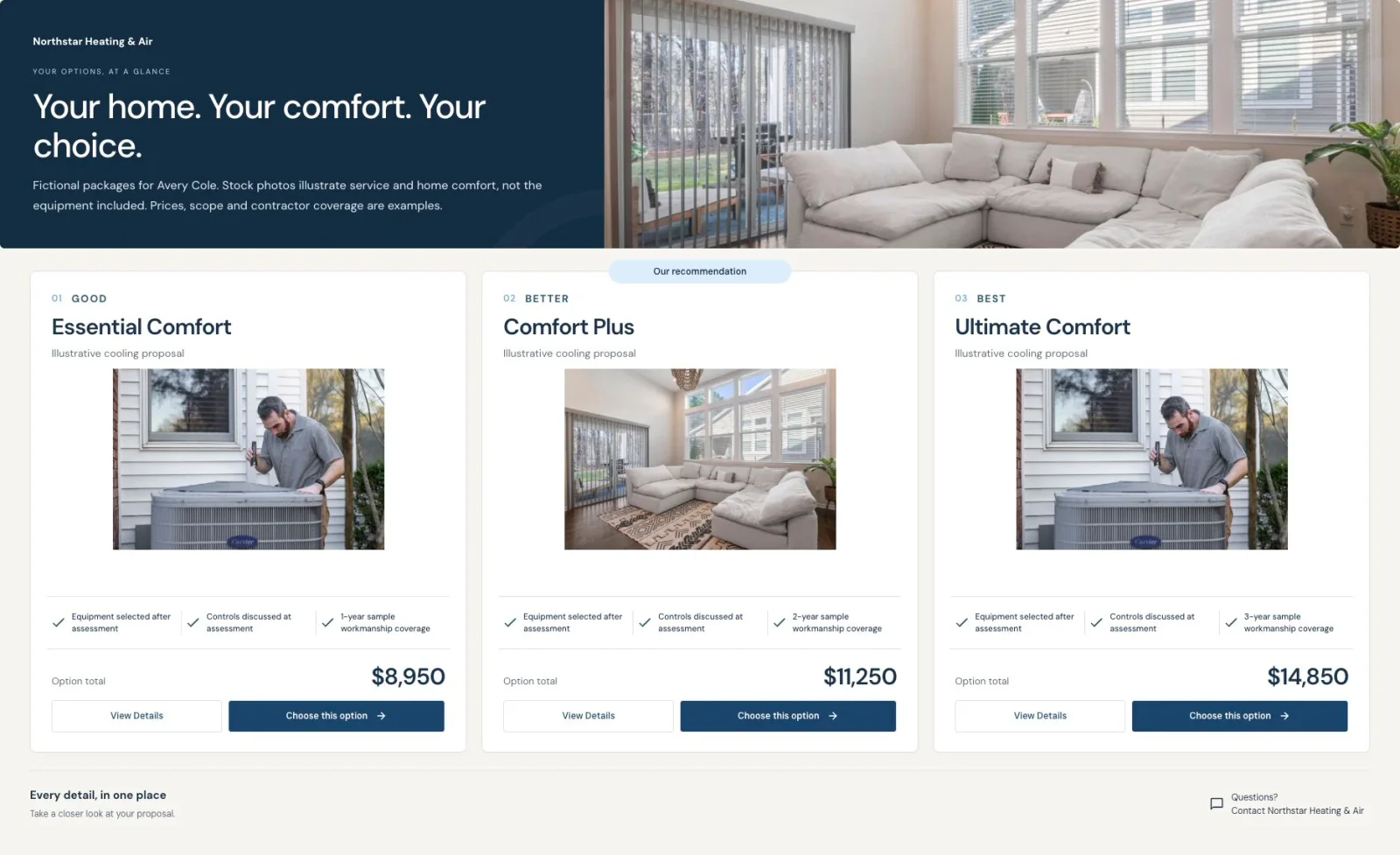
Existing customer-facing IKOK offering detail using fictional demo records. This view illustrates the information a customer can review; it does not show the proposal editor or establish the terms of Elena's offer.
Separate warranty, labor and maintenance
“Coverage included” leaves too much unexplained. June checks three distinct commitments:
- Manufacturer warranty: identify the applicable written terms, covered items, conditions and exclusions. Do not summarize a parts warranty as coverage for every repair expense.
- Contractor labor coverage: explain the labor commitment actually offered, its duration, conditions and exclusions. Keep it distinguishable from manufacturer coverage.
- Maintenance service: describe included visits or services and their terms separately. A maintenance benefit is not automatically a warranty or unlimited repair coverage.
In Elena's example, the team states the same applicable parts and labor terms across all three options. Maintenance is presented separately rather than implied by the package name. If the customer also wants recurring service, the maintenance agreement workflow covers the separate service and billing decisions.
Use a short review checklist before sending
June owns the final customer-view check; Mateo confirms technical scope and the offer's commitments. A solo contractor can perform both reviews at separate moments.
Before releasing a proposal, check:
- Customer, property and person authorized to approve are correct.
- Every option includes the shared work and necessary corrections.
- Equipment, controls, images and specifications match the intended offer.
- Differences are understandable without relying on package labels.
- Prices, exclusions, coverage and payment terms agree throughout.
- Open questions have an owner, and the customer sees what remains unresolved.
This checklist is reusable. Its answers must come from the current job, not assumptions carried forward from the last proposal.
For a small team, the value is a dependable reference. June can explain what is included without reconstructing Mateo's site conversation, while Mateo can check the same information Elena will receive.
Carry the accepted scope into the job
Suppose Elena selects the package with a new programmable control. Before scheduling the work, June confirms the accepted document, selected option, shared ductwork correction, agreed terms and approving person.
Her handoff note identifies the property, accepted proposal version, equipment and control, included work, exclusions, open dependencies and next responsible person. Mateo checks that the planned work matches that record.
A selection or conversation should not be treated as proof that every required approval or payment step has happened. Confirm those separately through the team's actual process.
For several early proposals, record the questions customers ask and any scope corrections found before scheduling. Repeated questions can reveal a weak description worth improving. Once the first proposal is ready, use the separate estimate follow-up guide to plan the next conversation.
Questions HVAC business owners ask
Do we need three options on every proposal?
No. IKOK supports presentations with one, two or three options. Use the number that reflects appropriate choices for the job. One clear scope is useful when there is only one suitable offer.
Can we reuse a proposal without copying old job details?
Reusable templates provide a starting structure. Review customer, property, equipment, quantities, prices and terms each time. The final customer preview is where the team checks the assembled offer.
What if someone other than Elena approves?
Pause the handoff and confirm who is authorized to approve the work. Record the actual approver and accepted scope; do not assume the person receiving the link has approval authority.
Walk through your own proposal
Bring a current replacement quote and one question customers regularly ask to an IKOK proposal walkthrough. Review how your shared scope, options and coverage would appear to a customer, and confirm the setup and plan details your business needs.
Photo: Existing IKOK demonstration with fictional Northstar Heating & Air packages for Avery. Prices, scope and coverage are examples; licensed stock photographs are illustrative. This separate demo does not depict Elena’s project. Reviewed November 23, 2026.